
A hybrid bike works by combining design features from road bikes and mountain bikes to create a versatile bicycle for everyday riding. It usually has flat handlebars, medium-width tires, multiple gears, and an upright riding position, making it suitable for city streets, bike paths, light trails, and commuting. If you are wondering how does a hybrid bike work, the answer comes down to how its frame, gears, brakes, tires, and riding geometry work together to balance speed, comfort, control, and efficiency.
What Is a Hybrid Bike?
A hybrid bike is designed to provide a practical middle ground between a road bike and a mountain bike. It usually feels faster and lighter than a mountain bike while offering more comfort and stability than a traditional road bike. This combination makes hybrid bikes popular for commuting, fitness riding, casual cycling, and mixed-surface trips.
A Mix of Road and Mountain Bike Features
Hybrid bikes borrow useful elements from several bicycle categories. From road bikes, they often take lighter frames, smoother rolling tires, and efficient gearing. From mountain bikes, they commonly use flat handlebars, wider tires, and a more upright riding posture.
This blend helps the rider move efficiently on pavement without sacrificing too much stability on rougher surfaces.
Designed for Everyday Versatility
Unlike highly specialized bicycles, hybrid bikes are built for a variety of riding situations. They can handle daily commutes, neighborhood rides, paved trails, and some gravel paths.
This versatility makes them attractive to riders who want one bike rather than separate models for different types of cycling.
Comfortable Riding Position
Most hybrid bikes place the rider in a relatively upright position. This can improve visibility in traffic and reduce the aggressive forward lean associated with many road bikes.
The riding position also makes steering feel more natural for beginners and casual cyclists.
How a Hybrid Bike Moves
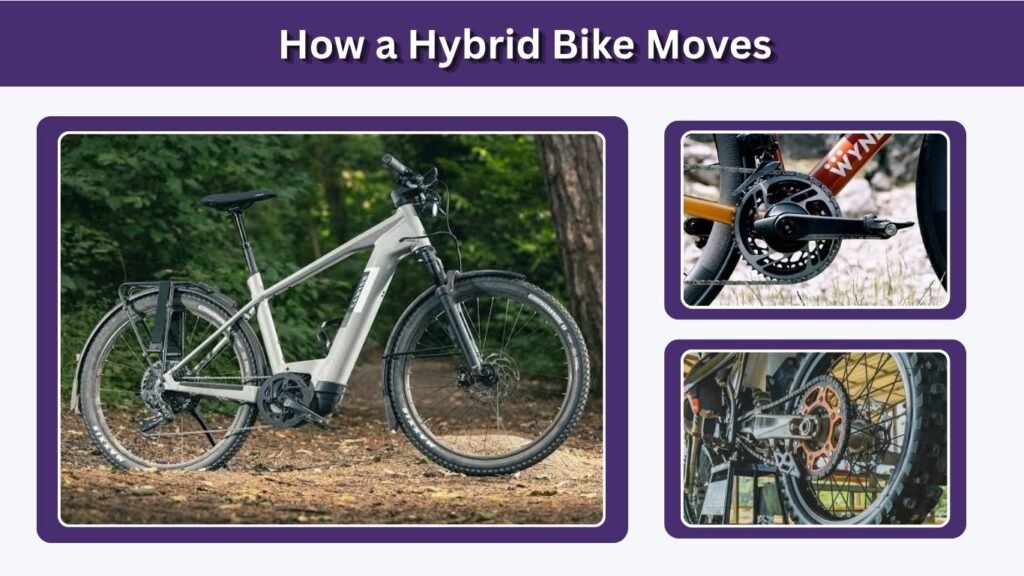
A hybrid bike moves using the same basic mechanical system as most bicycles. When the rider pushes the pedals, that force travels through the drivetrain to the rear wheel. The tires then transfer that power to the ground, moving the bike forward. Different gears help the rider control how much effort is required depending on speed and terrain.
Pedals and Crankset Transfer Your Power
The process starts when the rider turns the pedals.
The pedals are attached to crank arms, which rotate the crankset. The crankset includes one or more chainrings connected to the bicycle chain.
As the rider pedals, the chain moves and transfers power toward the rear wheel.
The Chain Drives the Rear Wheel
The chain runs from the front chainring to the rear cassette or freewheel.
When the chain pulls on one of the rear gears, it causes the rear wheel to rotate. The wheel pushes against the ground, moving the bicycle forward.
The faster the rider pedals and the more efficiently the drivetrain transfers power, the faster the bike can travel.
Wheels Convert Pedaling Into Forward Motion
Once the rear wheel begins turning, the tires grip the road surface.
Hybrid-bike tires are typically wider than road-bike tires but narrower and smoother than most mountain-bike tires. This allows them to roll efficiently on pavement while still providing useful traction and stability.
How Hybrid Bike Gears Work
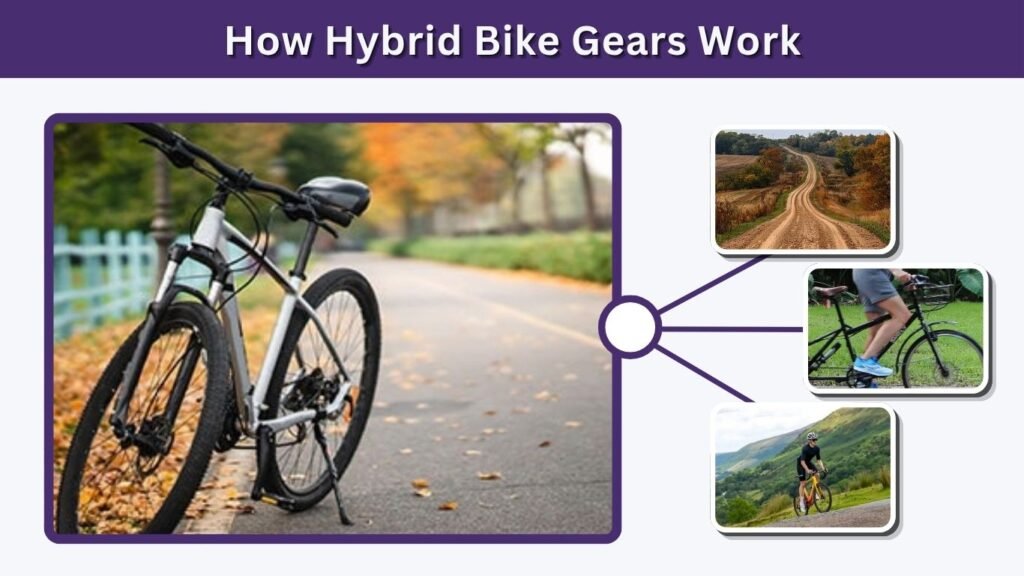
The gearing system is one of the most important parts of a hybrid bike because it allows the rider to adjust pedaling effort. Lower gears make climbing easier, while higher gears help maintain speed on flat roads or downhill sections. Most hybrid bikes use derailleur-based systems, though some models use internal gear hubs instead.
Lower Gears Make Hills Easier
Lower gears reduce the amount of force needed to turn the pedals.
They are useful for:
- Riding uphill
- Starting from a stop
- Cycling against strong wind
- Riding on rough surfaces
- Carrying additional weight
In a lower gear, the rider pedals more quickly but with less resistance.
Higher Gears Help Maintain Speed
Higher gears require more effort per pedal stroke but can help the bike move farther with each rotation.
They work best for:
- Flat roads
- Downhill riding
- Faster commuting
- Open bike paths
- Maintaining higher cruising speeds
Riders usually shift gradually as speed and terrain change.
Derailleurs Move the Chain Between Gears
Most hybrid bikes use front and rear derailleurs.
These components guide the chain from one gear to another when the rider uses the shifters on the handlebars. Modern hybrid bikes may have one, two, or three front chainrings depending on their design.
Some newer models use a single front chainring to simplify shifting.
How Hybrid Bike Brakes Work
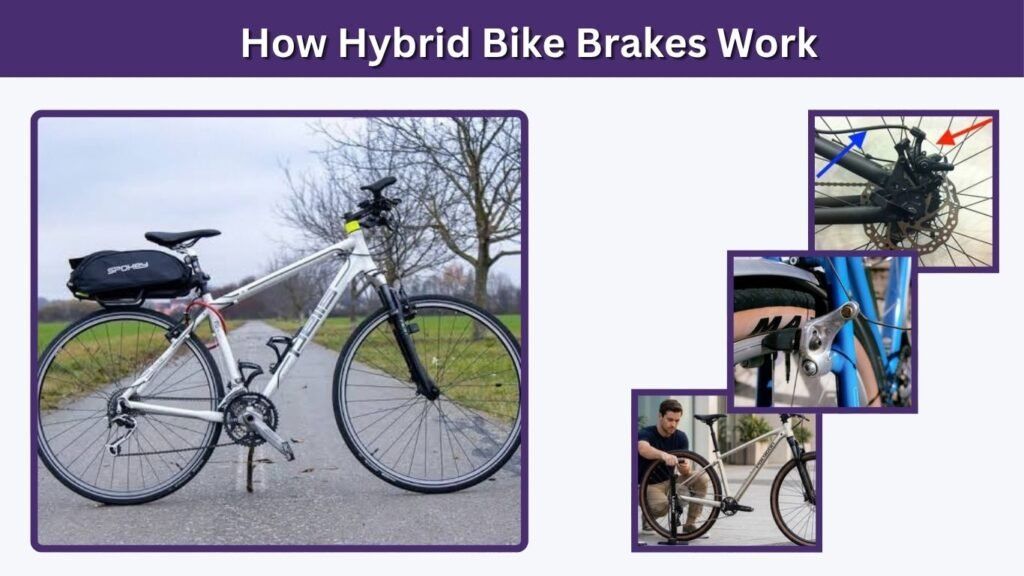
Hybrid bikes need reliable braking because they are often used around traffic, pedestrians, hills, and changing road conditions. Most models use either rim brakes or disc brakes. Both systems create friction to slow the wheels, but they do so in different ways and may perform differently in wet or muddy conditions.
Rim Brakes
Rim brakes use brake pads that press against the outer rim of the wheel.
When the rider squeezes a brake lever:
- The brake cable or hydraulic system activates
- The pads move toward the rim
- Friction slows the wheel
- The bike gradually reduces speed
Rim brakes are generally simple, lightweight, and easy to maintain.
Disc Brakes
Disc brakes use a metal rotor mounted near the wheel hub.
A brake caliper squeezes the rotor when the rider pulls the brake lever. This creates friction and slows the wheel.
Disc brakes are common on modern hybrid bikes because they can provide dependable braking in wet conditions.
Front and Rear Brakes Work Together
Most hybrid bikes have separate front and rear brake controls.
Using both brakes together usually provides smooth and controlled stopping. The front brake provides significant stopping power, while the rear brake helps maintain stability.
Learning to apply both progressively can improve control.
How Hybrid Bike Tires Affect Performance
Hybrid-bike tires are designed to balance speed and comfort. They are usually wider than traditional road-bike tires, which provides greater stability, but they often have smoother tread than mountain-bike tires to reduce rolling resistance. Tire width, pressure, and tread pattern can all change how the bike feels on different surfaces.
Medium-Width Tires Improve Versatility
Hybrid tires commonly fall between narrow road tires and wide mountain-bike tires.
This allows them to perform well on:
- Pavement
- Bike lanes
- Paved trails
- Hard-packed gravel
- Light dirt paths
The extra width can also absorb small bumps more effectively than very narrow road tires.
Tire Pressure Changes the Ride Feel
Higher tire pressure generally reduces rolling resistance on smooth roads, while slightly lower pressure can improve comfort and traction.
However, pressure should always remain within the range recommended for the tire.
Riders can adjust pressure depending on body weight, road surface, and desired comfort.
Tread Pattern Matters
Some hybrid tires are almost completely smooth, while others have shallow tread patterns.
Smooth tires are typically better for road-heavy riding. Tires with moderate tread are more useful when the rider regularly encounters gravel, dirt, or uneven paths.
How the Hybrid Bike Frame and Geometry Work

The frame determines much of how a hybrid bike feels. Most hybrid frames are designed to provide stable handling, comfortable posture, and efficient pedaling. Compared with racing road bikes, hybrids usually place the rider in a more relaxed position. Compared with mountain bikes, they are often lighter and more efficient on pavement.
Flat Handlebars Improve Control
Most hybrid bikes use flat or slightly raised handlebars.
These handlebars provide:
- Direct steering
- Comfortable hand placement
- Good visibility
- Easy access to brakes
- Simple gear shifting
This setup is especially useful in urban environments where riders need to react quickly.
Upright Geometry Improves Comfort
The frame geometry usually positions the rider higher and more upright than a performance road bike.
This can make it easier to see traffic, pedestrians, and obstacles ahead.
It may also feel more comfortable for riders who do not want an aggressive racing position.
Frame Materials Affect Weight and Feel
Hybrid bikes commonly use aluminum, steel, or carbon fiber frames.
Aluminum is popular because it is relatively light and affordable. Steel can provide a comfortable and durable ride, while carbon fiber may reduce weight and vibration on higher-end models.
How Suspension Works on Some Hybrid Bikes

Not every hybrid bike has suspension, but some models include a front suspension fork to improve comfort on rough roads and light trails. Suspension compresses when the front wheel hits bumps, helping reduce the amount of impact transferred to the rider. However, suspension can also add weight and slightly reduce pedaling efficiency on smooth roads.
Front Suspension Absorbs Bumps
A suspension fork allows the front wheel to move slightly up and down.
This can make riding more comfortable on:
- Broken pavement
- Gravel roads
- Light trails
- Uneven sidewalks
- Rough bike paths
For riders who frequently encounter uneven terrain, suspension can be useful.
Rigid Forks Are More Efficient
Many hybrid bikes use rigid forks instead of suspension.
Rigid forks are lighter and transfer pedaling energy more efficiently on smooth roads.
They are often preferred for commuting and fitness riding where pavement makes up most of the route.
How a Hybrid Bike Handles Different Surfaces
One of the main advantages of a hybrid bike is its ability to work on several types of terrain. It is not as fast as a dedicated road bike on smooth pavement or as capable as a mountain bike on technical trails, but it offers a practical compromise for riders who encounter mixed riding conditions.
Riding on Pavement
Hybrid bikes work especially well on paved roads and bike paths.
Their relatively smooth tires reduce rolling resistance, while the upright riding position provides comfort and visibility.
For commuting and recreational road riding, this combination can be very practical.
Riding on Gravel
Many hybrid bikes can handle light gravel and compact dirt surfaces.
Wider tires provide more stability than narrow racing tires, especially when tire pressure is adjusted appropriately.
However, rough gravel may require wider tires or a gravel-specific bike.
Riding on Light Trails
Some hybrid bikes can manage gentle trails, especially models with wider tires or front suspension.
They are not designed for aggressive jumps, steep technical descents, or rocky mountain-bike trails.
For casual off-road riding, though, a hybrid can be surprisingly capable.
Why Hybrid Bikes Are Efficient for Commuting
Hybrid bikes are commonly used for commuting because they balance speed, comfort, control, and practicality. Riders can move efficiently through urban areas without needing the aggressive position of a road bike. Many models also include mounting points for racks, fenders, kickstands, and bottle cages.
Comfortable for Daily Riding
The upright position can reduce strain during moderate-distance rides.
Flat handlebars also make it easier to control the bike in traffic and at lower speeds.
These features can make regular commuting feel more manageable.
Easy to Add Accessories
Many hybrid bikes allow useful accessories such as:
- Rear racks
- Panniers
- Fenders
- Lights
- Bottle cages
- Kickstands
- Handlebar bags
These additions can turn a basic hybrid bike into a practical transportation option.
Good Balance of Speed and Stability
Hybrid bikes are typically faster than heavy mountain bikes on pavement but more stable than narrow-tire road bikes.
That balance is one reason they are commonly chosen for mixed daily use.
How to Ride a Hybrid Bike Efficiently
Getting the most from a hybrid bike depends partly on riding technique. Proper gear selection, tire pressure, braking, and bike fit can make riding smoother and more efficient. Even a well-designed bike may feel uncomfortable or sluggish if the saddle height, gears, or tire pressure are not adjusted correctly.
Use the Right Gear
Shift into a lower gear before steep climbs rather than waiting until pedaling becomes extremely difficult.
On flat roads, gradually shift into higher gears as speed increases.
Try to maintain a smooth, comfortable pedaling rhythm instead of pushing extremely hard gears.
Set the Saddle Height Correctly
A saddle that is too low can make pedaling inefficient, while one that is too high can cause discomfort and poor control.
When the pedal reaches the bottom of its rotation, the rider’s knee should generally remain slightly bent rather than fully locked.
Maintain Proper Tire Pressure
Check tire pressure regularly.
Underinflated tires can make pedaling harder and increase the risk of certain types of flats. Excessively high pressure can make the ride harsher and may reduce traction on uneven surfaces.
Follow the tire manufacturer’s recommended pressure range.
FAQs
1. How does a hybrid bike work differently from a road bike?
A hybrid bike uses the same basic pedal-and-chain drivetrain as a road bike, but it typically has flat handlebars, wider tires, and a more upright riding position. These features make it more comfortable and versatile for everyday riding.
2. Is a hybrid bike good for beginners?
Yes. Hybrid bikes are often suitable for beginners because they generally provide stable handling, comfortable geometry, straightforward controls, and the ability to ride on several common surfaces.
3. Can a hybrid bike go fast?
Yes. A hybrid bike can reach good speeds on pavement, especially with smooth tires and efficient gearing. However, a dedicated road bike is usually faster because of its lighter weight, narrower tires, and more aerodynamic riding position.
4. Can hybrid bikes be used on trails?
Hybrid bikes can usually handle paved trails, compact dirt, and light gravel. Models with wider tires or suspension can manage slightly rougher terrain, but hybrids are not intended for demanding mountain-bike trails.
5. How many gears does a hybrid bike need?
The ideal number depends on the terrain and riding style. Riders in flat areas may need fewer gears, while those riding hills may benefit from a wider gear range. Modern hybrids commonly use simple 1x drivetrains or multi-chainring systems.
