
Getting the right hybrid bike tire pressure can make a big difference in your riding comfort, speed, and safety. Whether you’re commuting on city roads, exploring gravel paths, or enjoying weekend rides, properly inflated tires provide better handling and control. However, the ideal pressure depends on several factors, including tire width, rider weight, and terrain. This guide explains recommended tire pressure for hybrid bikes, provides a practical PSI chart, and shows you how to adjust inflation for a smoother, more efficient ride.
What Is the Recommended Hybrid Bike Tire Pressure?
Most hybrid bikes use tires wider than traditional road bike tires but narrower than typical mountain bike tires. As a broad starting point, many hybrid tires operate somewhere around 35–70 PSI, although some require pressures outside this range. The correct setting depends on tire construction, width, weight, and riding conditions. Always check the pressure limits printed on your tire and specified for your rim.
Average Tire Pressure for Hybrid Bikes
Hybrid bikes generally require different inflation pressures depending on tire width and riding style.
- Narrow hybrid tires (28–32 mm): Often approximately 55–75 PSI.
- Medium hybrid tires (35–38 mm): Often approximately 45–65 PSI.
- Wide hybrid tires (40–45 mm): Often approximately 35–55 PSI.
- Extra-wide hybrid tires (47–50 mm): Often approximately 30–45 PSI.
These are illustrative starting ranges for conventional setups, not universal manufacturer recommendations. Some tubeless configurations use lower pressures.
Why Proper Tire Pressure Matters
Correct tire pressure supports efficient rolling, predictable handling, and comfortable riding. Excessively high pressure can make a hybrid bike feel harsh on uneven roads, while insufficient pressure may cause sluggish handling, tire deformation, or pinch flats in tubed tires.Finding a suitable balance helps improve traction and reduce unnecessary vibration, especially during longer commutes.
Hybrid Bike Tire Pressure Chart by Tire Size
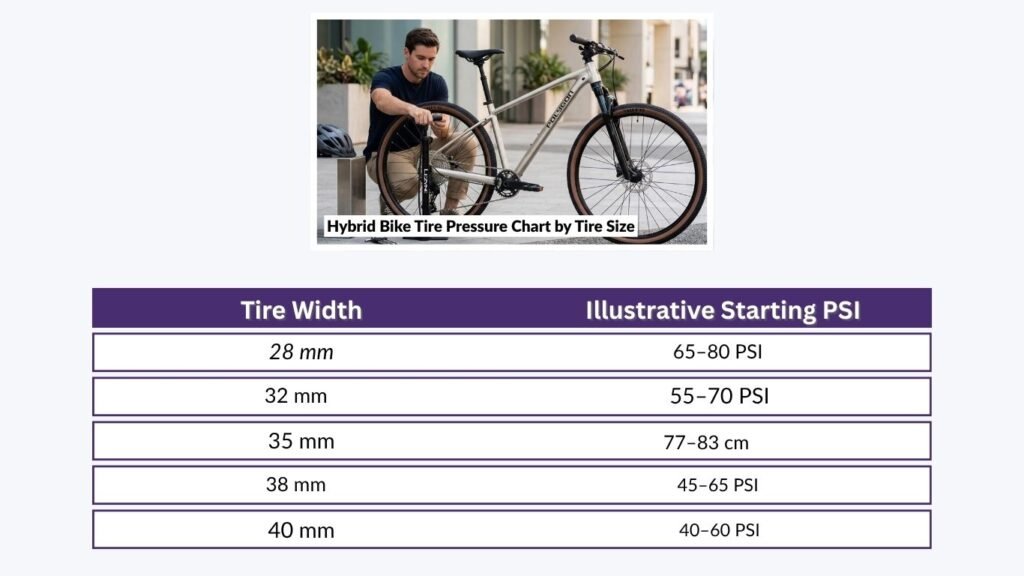
Tire width is one of the most important factors when determining hybrid bike air pressure. Wider tires generally support the same load at lower inflation pressures than narrower tires. However, the ideal setting also changes with rider weight, tire casing, and road conditions. The following chart offers approximate starting points for everyday riding, rather than fixed pressure specifications.
Hybrid Bike Tire Pressure PSI Chart
| Tire Width | Illustrative Starting PSI | Typical Use |
| 28 mm | 65–80 PSI | Smooth paved roads |
| 32 mm | 55–70 PSI | City commuting |
| 35 mm | 45–65 PSI | Urban and fitness riding |
| 38 mm | 40–60 PSI | Mixed pavement |
| 40 mm | 35–55 PSI | City roads and light gravel |
| 45 mm | 30–45 PSI | Rough roads and gravel |
| 50 mm | 25–40 PSI | Uneven paths and trails |
These approximate ranges assume ordinary riding loads and compatible equipment. They are not suitable for every tire, particularly certain tubeless or hookless-rim combinations.
Understanding PSI and BAR
PSI measures tire pressure in pounds per square inch, while BAR is another commonly used unit.
For example, 40 PSI is approximately 2.76 BAR, and 60 PSI is approximately 4.14 BAR. Most bicycle floor pumps display both measurements, allowing riders to adjust inflation accurately.
How Rider Weight Affects Hybrid Bike Tire Pressure
Rider weight has a significant influence on the amount of air required inside hybrid bicycle tires. Heavier loads generally need higher inflation pressure to prevent excessive tire deformation, while lighter riders can often use lower settings for better comfort. The total load includes the rider, bicycle, and any luggage. Appropriate pressure also depends on tire width and construction.
Hybrid Bike Tire Pressure by Weight
- Lightweight riders: May prefer the lower portion of a suitable pressure range.
- Average-weight riders: Can begin near the middle of the approved range.
- Heavier riders: Often benefit from higher pressure within the permitted range.
- Riders carrying luggage: Should account for the additional load when adjusting inflation.
Front vs. Rear Tire Pressure
Rear bicycle tires usually carry more weight than front tires. Therefore, rear tire pressure may need to be slightly higher, although the ideal difference depends on weight distribution.For example, a rider might find 45 PSI in the front and 48 PSI in the rear comfortable on a particular setup. These numbers are only illustrative and must remain within the equipment’s approved limits.
Best Hybrid Bike Tire Pressure for Different Terrains
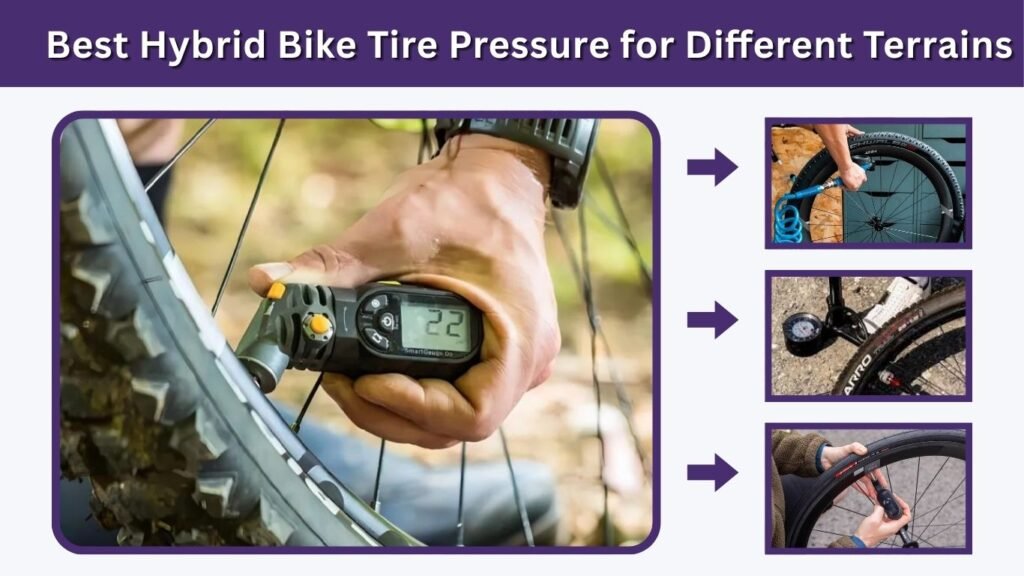
Hybrid bicycles are designed to handle different riding environments, including city streets, paved cycling paths, and light gravel trails. However, using identical tire pressure everywhere may reduce comfort or traction. Adjusting inflation to match surface conditions helps maintain efficient rolling and predictable handling. The correct adjustment depends on your tire dimensions, total riding weight, and surface roughness.
Tire Pressure for Smooth Roads
Smooth pavement generally allows hybrid cyclists to use moderately higher pressure within the recommended range.Proper inflation reduces excessive tire deformation and helps maintain responsive handling. However, maximum pressure is not automatically the fastest or most comfortable choice.
Tire Pressure for Gravel Roads
Gravel and uneven roads generally benefit from slightly lower tire pressure.Lower inflation allows the tire to conform more effectively to surface irregularities, improving comfort and grip. Avoid reducing pressure so far that the rim strikes obstacles or the tire becomes unstable.
Tire Pressure for Wet Conditions
Wet surfaces require careful handling and reliable traction. Depending on the tires and terrain, a modest pressure reduction may improve contact with uneven ground.However, pressure alone cannot compensate for slippery surfaces. Appropriate tires, controlled speed, and smooth braking are essential.
How to Check and Adjust Hybrid Bike Tire Pressure
Maintaining correct tire inflation is a simple but important bicycle maintenance task. Tires gradually lose air, even when a bike is not frequently used. Regular pressure checks help prevent poor handling, excessive tire movement, and avoidable punctures. A floor pump with a reliable pressure gauge is usually the most convenient tool for maintaining consistent tire pressure at home.
Steps to Inflate Hybrid Bike Tires
- Check the tire sidewall: Locate the manufacturer’s minimum and maximum pressure markings.
- Identify the valve: Determine whether the tire uses a Presta or Schrader valve.
- Attach the pump: Secure the compatible pump head to the valve.
- Measure existing pressure: Read the gauge before adding air.
- Inflate gradually: Pump to your chosen pressure within the approved limits.
- Recheck the pressure: Confirm the reading and securely close the valve.
How Often Should You Check Tire Pressure?
Checking hybrid bike tire pressure before longer rides is a useful habit. Frequent commuters should check it regularly, ideally before riding, especially when using tires that lose pressure quickly.A floor pump with a gauge is more reliable than squeezing the tire by hand.
Hybrid Bike Tire Pressure for Popular Brands
Popular bicycle manufacturers such as Trek, Specialized, Giant, Cannondale, and Schwinn offer hybrid bikes with different tire widths and wheel configurations. Because each model may use different tires, there is no single correct pressure for every bike from a particular brand. The tire’s specifications, rim compatibility, and total riding load should always guide inflation decisions.
Trek Hybrid Bike Tire Pressure
Trek hybrid bikes, including different FX and Dual Sport configurations, may require different pressures depending on their tires.
Check the exact tire size and inflation markings rather than assuming every Trek hybrid uses identical PSI.
Specialized and Giant Hybrid Bike Tire Pressure
Specialized and Giant hybrid bicycles may be equipped with tires intended for paved roads, mixed surfaces, or comfortable recreational riding.Narrower tires generally require higher pressures than wider alternatives carrying equivalent loads. Follow the installed tire and wheel specifications.
Cannondale and Schwinn Hybrid Bike Tire Pressure
Cannondale and Schwinn hybrids also vary in tire design and recommended inflation.Whether riding a fitness-focused hybrid or a comfort-oriented model, always use the limits appropriate for its actual tire and rim combination.
How to Find the Ideal Hybrid Bike Tire Pressure
Finding your ideal pressure involves more than following a general chart. Tire width, rider weight, total luggage, terrain, and tire construction all influence the result. A pressure calculator can provide a personalized starting point, but real-world adjustments are still necessary. Any suggested value must respect the restrictions established by your tire and wheel manufacturers.
Using a Hybrid Bike Tire Pressure Calculator
A bicycle tire pressure calculator can estimate suitable front and rear inflation levels using your riding information.The bike tire pressure considers system weight, measured tire width, surface conditions, and tire type. Its results are estimates rather than guarantees of equipment compatibility.
Adjusting Pressure for Comfort and Performance
Start with an appropriate pressure within the manufacturer’s limits and evaluate how the bicycle feels.If the ride feels harsh, a small reduction may improve comfort. If the tire feels unstable or frequently bottoms out, more pressure may be necessary.Always prioritize safe handling over achieving a particular PSI number.
Common Hybrid Bike Tire Pressure Mistakes
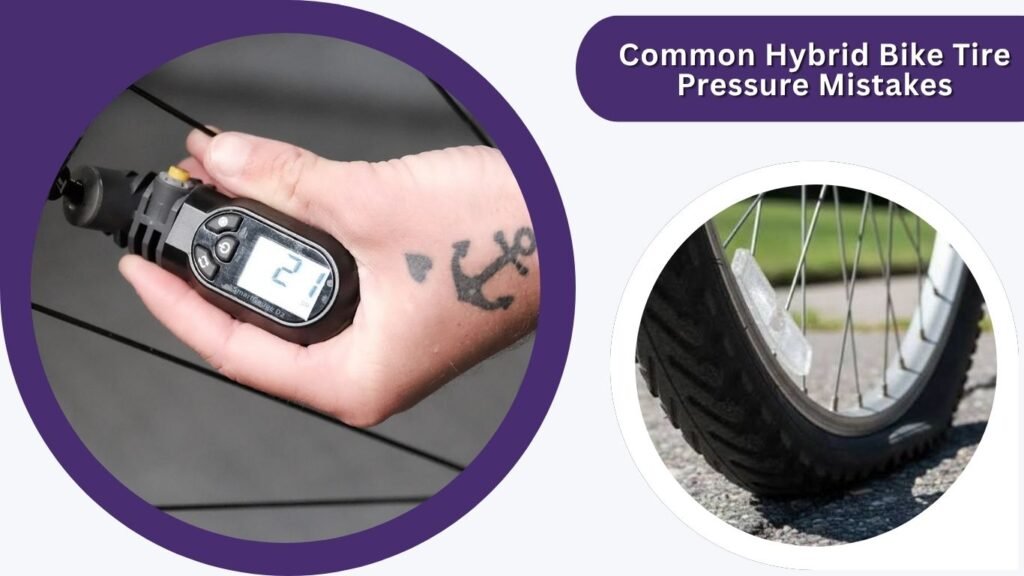
Incorrect tire inflation can negatively affect riding comfort, performance, and tire durability. Many cyclists either inflate their tires to the maximum printed pressure or ride without checking pressure regularly. Both habits can create problems, particularly when riding across varying road conditions. Understanding common mistakes helps maintain consistent handling and reduces the risk of avoidable tire-related issues.
Overinflating Hybrid Bike Tires
Excessive pressure can make tires feel rigid, reducing comfort on rough pavement.Overinflation beyond the tire or rim limits can also create serious safety risks. Never assume the maximum sidewall pressure is the ideal everyday setting.
Riding With Underinflated Tires
Insufficient inflation can cause sluggish handling, increased tire deformation, and pinch flats when using inner tubes.Extremely low pressure may also allow the rim to contact obstacles, potentially damaging the wheel.
Ignoring Tire and Rim Specifications
Every tire and rim has specific compatibility and inflation requirements.This is particularly important for tubeless and hookless systems, which may have stricter pressure limits than conventional setups.
FAQs
1. What Is the Best Tire Pressure for a Hybrid Bike?
There is no single best pressure for all hybrid bikes. Many conventional setups operate around 35–70 PSI, but the ideal value depends on tire width, rider weight, terrain, and tire construction. Always follow the tire and rim specifications.
2. Is 55 PSI Good for Hybrid Bike Tires?
Yes, 55 PSI can be appropriate for certain hybrid tires, particularly some medium-width tires used on paved roads. However, it may be excessive for wider tubeless tires or unsuitable for tires with lower maximum pressure limits.
3. Should Hybrid Bike Tires Have the Same Pressure?
Not necessarily. The rear tire often supports more weight, so it may benefit from slightly higher pressure than the front. The appropriate difference depends on total load, tire dimensions, and riding conditions.
4. What Happens if Hybrid Bike Tire Pressure Is Too Low?
Low tire pressure can cause sluggish handling, excessive tire deformation, and increased risk of pinch flats in tires with inner tubes. Severe underinflation may also damage the rim when riding over obstacles.
5. How Much Air Should I Put in 700c Hybrid Bike Tires?
The 700c measurement describes the wheel’s nominal diameter, not the required inflation pressure. The correct PSI depends primarily on tire width, construction, riding load, and manufacturer limits. For example, a 700×32c tire generally requires more pressure than a 700×45c tire carrying the same load.
